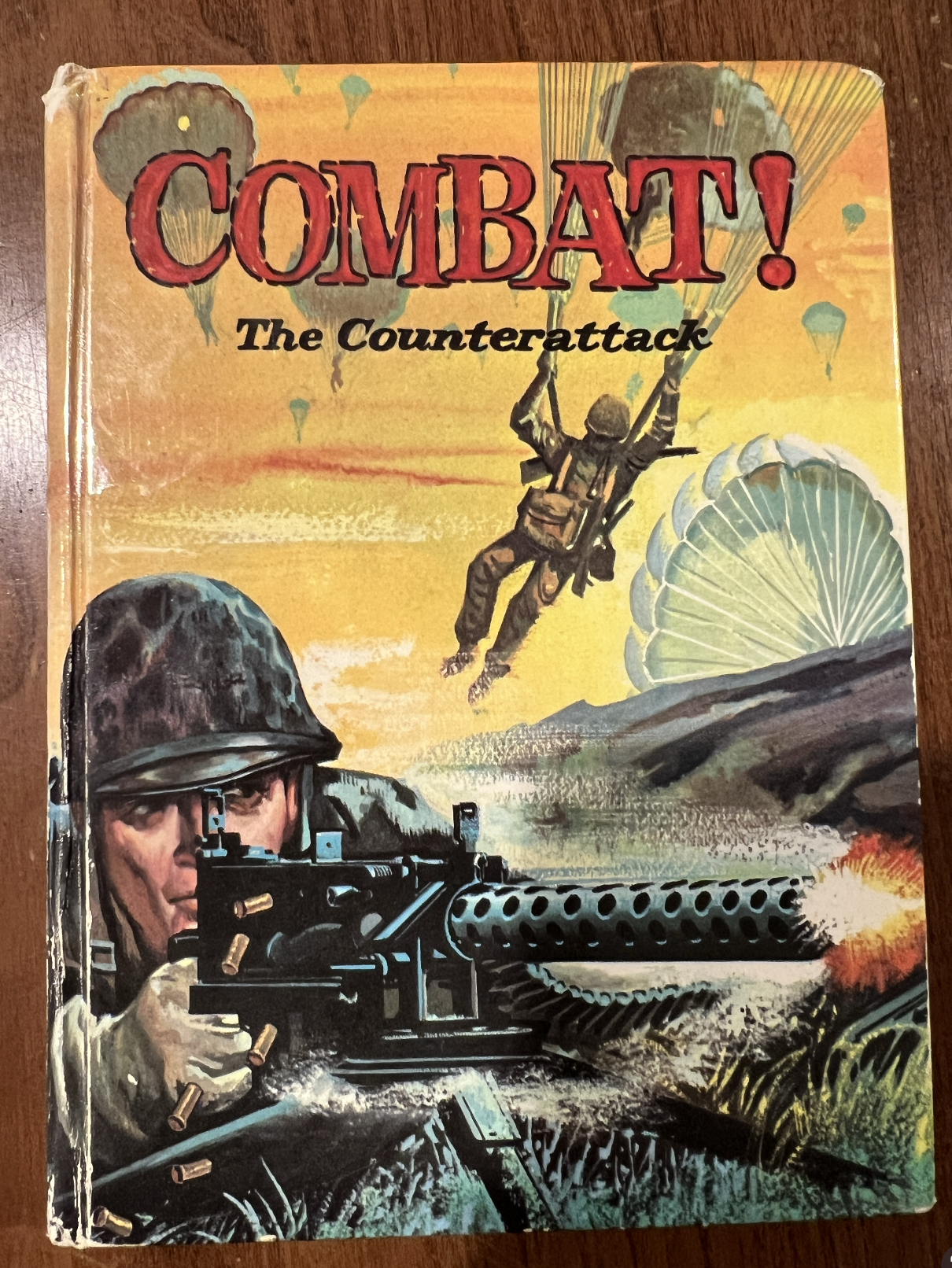
As war continues to ripple through geopolitics—and inch ever closer to home—it has drawn me back to my shelves, where its influence bleeds quietly into almost every section.
War and conflict is a category that carries weight. Not because it glorifies violence, but because it offers clarity, context, and scale. It is a way to measure the world, and over time, a way to measure myself. The books gathered here span photo books, graphic novels, comics, nonfiction, and fiction—each medium revealing something the others cannot.
Some works document war directly. Photo books by Eddie Adams, Don McCullin, Lynsey Addario, and David Douglas Duncan freeze moments that refuse to stay contained within the frame. These images are not spectacles; they are evidence. They remind us that violence is not abstract, and that witnessing carries its own ethical burden. The camera does not neutralize suffering—it preserves it.
Other books explore war through memory and reflection. Man’s Search for Meaning, The Long Walk, The Things They Carried, Born on the Fourth of July, and Hiroshima focus less on battle than on endurance. They trace how conflict reshapes identity, belief, and time itself. War may end on paper, but it persists in the body, in memory, and in silence passed between generations.
Graphic novels and illustrated works approach war through simplification without diminishing impact. Maus, Barefoot Gen, Safe Area Goražde, They Called Us Enemy, and Onward Towards Our Noble Deaths use restraint, metaphor, and visual economy to convey trauma that prose alone often cannot. In reducing form, they sharpen meaning. The distance they create allows the truth to land harder.
There is also war refracted through fiction and fantasy. Works like The Forever War, Gates of Fire, and Malazan: Deadhouse Gates, reject romanticism. Armies function as institutions rather than instruments of glory. Soldiers endure logistics, command failures, boredom, terror, and loyalties shaped by necessity rather than choice. Victory is never pure. Discipline becomes both survival mechanism and moral burden. It is no coincidence that many veterans gravitate toward speculative fiction—distance allows honesty. Fantasy and science fiction create space to examine war without reenacting it.
For many veterans, myself included, this category carries a complicated nostalgia—one flavored with anxiety. A longing for simpler times. Mission, gym, chow hall, editing, sleep. Some of the most exciting and most stressful moments of life relegated to memory, a lifetime ago yet ever-present when the mind wanders. My own passage into adulthood came through the lens of a combat cameraman. My exposure to violence was digitized, framed, archived. That experience is constantly weighed and reinterpreted as age and reflection take hold—much like returning to a book and discovering new meaning hidden in the familiar.
These works are not collected for answers. They are collected because they ask better questions. About power, belief, loyalty, and cost. About how societies justify violence, and how individuals live with it afterward. About the stories we tell to make sense of what cannot be undone.
Taken together, this section of the library is less about war itself than about its ripples—how conflict reshapes cultures, families, and inner lives long after the fighting stops. These books do not offer closure. They offer continuity. A reminder that understanding is not a destination, but a practice—one revisited, again and again, like a well-worn page.
Recommended Reading: Witnessing War, Memory, and Honor
As a continuation of the exploration in Category Spotlight: War & Conflict, these works offer focused glimpses into how conflict shapes individuals, societies, and imagination. Each title captures different facets of war’s legacy—personal endurance, cultural memory, moral complexity, and the human cost of violence.
Photojournalism & Direct Witness
Bigger Than the Frame
Author: Eddie Adams
Media type: Photo book
Year: 2002
Short note: Ethics of witnessing
Expanded note: Adams reflects on the moral weight of photographing violence. The book interrogates how images shape memory, responsibility, and historical record long after the shutter closes.
Life, Death and Everything in Between
Author: Don McCullin
Media type: Photo book
Year: 2011
Short note: Relentless witness
Expanded note: A lifetime of war photography stripped of sentimentality. McCullin documents suffering as repetitive and unresolved, emphasizing the cumulative psychological toll of conflict.
Of Love and War
Author: Lynsey Addario
Media type: Photo memoir
Year: 2015
Short note: Cost of seeing
Expanded note: Addario pairs frontline imagery with personal narrative, revealing how bearing witness reshapes relationships, identity, and emotional endurance.
This Is War
Author: David Douglas Duncan
Media type: Photo book
Year: 1951
Short note: Combat intimacy
Expanded note: Duncan’s Korean War photographs erase distance between subject and viewer, presenting war as chaotic, immediate, and profoundly human.
Memory, Endurance & Lived Experience
Man’s Search for Meaning
Author: Viktor E. Frankl
Media type: Nonfiction / Memoir
Year: 1946
Short note: Meaning under suffering
Expanded note: Frankl reframes survival as an existential act. War becomes a crucible for examining purpose, agency, and moral choice under extreme conditions.
The Long Walk
Author: Sławomir Rawicz
Media type: Memoir
Year: 1956
Short note: Survival beyond captivity
Expanded note: A trek shaped by war even after combat ends. Endurance here is physical, moral, and psychological—war’s imprint persists long after escape.
The Things They Carried
Author: Tim O’Brien
Media type: Fiction / Autobiographical
Year: 1990
Short note: Memory as burden
Expanded note: O’Brien collapses the line between fact and fiction to show how war lives on through memory, guilt, and unresolved fear.
Born on the Fourth of July
Author: Ron Kovic
Media type: Memoir
Year: 1976
Short note: Patriotism undone
Expanded note: A veteran’s reckoning with injury and national myth. The book traces how war fractures identity and belief long after the fighting stops.
Hiroshima
Author: John Hersey
Media type: Nonfiction / Journalism
Year: 1946
Short note: Civilian aftermath
Expanded note: Six ordinary lives reveal the intimate, irreversible consequences of modern warfare. The focus is not strategy, but survival.
Graphic & Illustrated Witness
Maus
Author / Illustrator: Art Spiegelman
Media type: Graphic memoir
Year: 1986–1991
Short note: Inherited trauma
Expanded note: By using metaphor and visual restraint, Maus examines how war’s trauma passes across generations, reshaping identity and memory.
Barefoot Gen
Author / Illustrator: Keiji Nakazawa
Media type: Graphic memoir
Year: 1973–1987
Short note: Civilian devastation
Expanded note: A child’s view of Hiroshima. The simplicity of form intensifies the horror, emphasizing how war permanently scars civilian life.
Safe Area Goražde
Author / Illustrator: Joe Sacco
Media type: Graphic journalism
Year: 2000
Short note: Life under siege
Expanded note: Sacco documents war as daily existence rather than spectacle, focusing on civilians navigating prolonged violence and scarcity.
They Called Us Enemy
Author: George Takei
Illustrator: Harmony Becker
Media type: Graphic memoir
Year: 2019
Short note: Domestic war ripple
Expanded note: Examines Japanese-American internment as a consequence of wartime fear, showing how conflict reshapes citizenship and belonging.
Onward Towards Our Noble Deaths
Author / Illustrator: Shigeru Mizuki
Media type: Manga
Year: 1973
Short note: Futility of sacrifice
Expanded note: Japanese soldiers abandoned by command reveal how honor collapses under institutional neglect and ideological rigidity.
Fiction, Fantasy & Speculative War
The Forever War
Author: Joe Haldeman
Media type: Science Fiction
Year: 1974
Short note: Veteran alienation
Expanded note: Time dilation mirrors the veteran experience—returning home to a world that has moved on, culturally and emotionally.
Gates of Fire
Author: Steven Pressfield
Media type: Historical Fiction
Year: 1998
Short note: Discipline over glory
Expanded note: War is framed as collective endurance rather than heroism. Identity is forged through suffering, repetition, and loyalty.
Malazan Book of the Fallen: Deadhouse Gates
Author: Steven Erikson
Media type: Epic Fantasy
Year: 2000
Short note: Institutional warfare
Expanded note: The Chain of Dogs arc portrays war as procedural and morally exhausting. Armies function as systems; soldiers endure logistics, command failure, and necessity-driven loyalty.