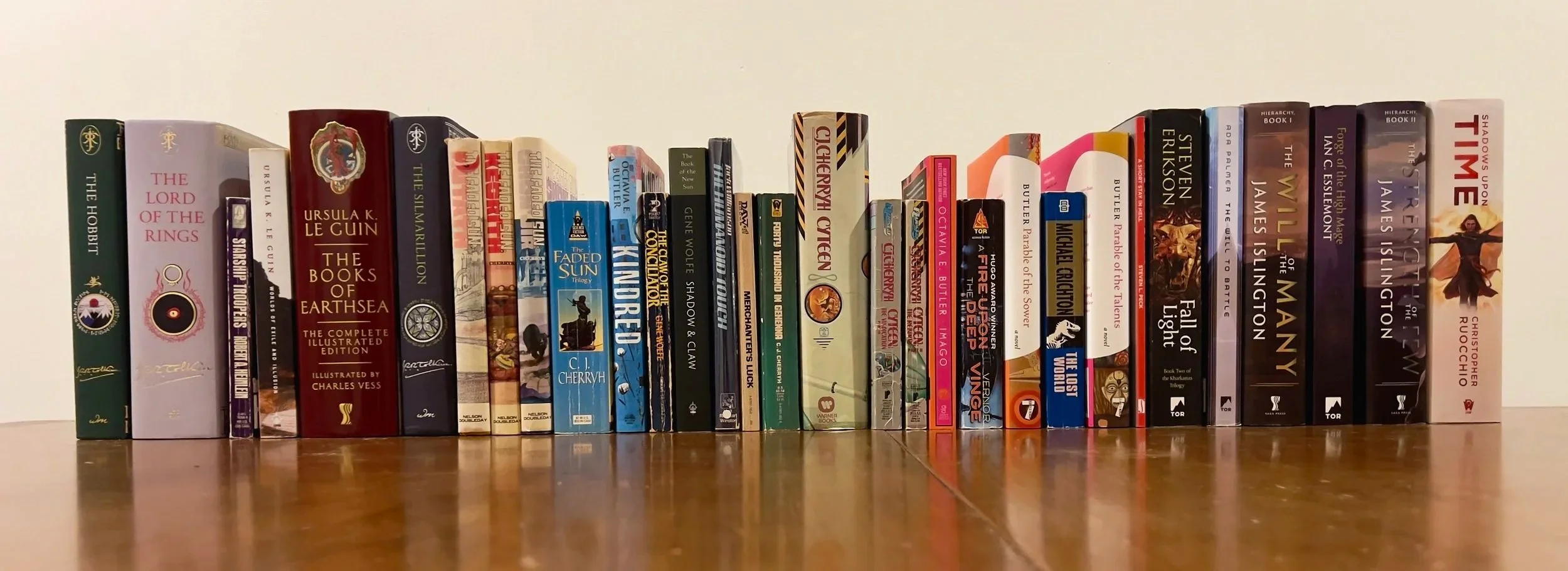
Books read in 2025, arranged chronologically by publication year (1937–2025).
42 books. ~18,000 pages. ~7.6 million words.
Not pictured: Ryan Cahill’s The Bound and the Broken — experienced in audio format.
The Hobbit – J.R.R. Tolkien (1937)
A deceptively simple adventure that establishes Tolkien’s moral universe. Beneath its whimsy lies a story about humility, restraint, and the cost of greed, introducing mythic structures that later expand into tragedy, history, and loss.
The Lord of the Rings – J.R.R. Tolkien (1954–1955)
An epic meditation on power, sacrifice, and endurance. Tolkien explores how domination corrodes intention, how hope persists through fellowship, and how victory often carries grief rather than triumph across generations.
Starship Troopers – Robert Heinlein (1959)
A provocative examination of military discipline, civic duty, and violence as moral education. Heinlein asks whether structured obedience can cultivate ethical citizenship or merely normalize conformity and sanctioned force.
Planet of Exile – Ursula K. Le Guin (1966)
A study in cultural survival under environmental and social pressure. Le Guin explores how adaptation, mistrust, and interdependence shape societies facing extinction-level isolation.
Rocannon’s World – Ursula K. Le Guin (1966)
The opening of the Hainish Cycle, blending anthropology, myth, and early interstellar contact. The novel examines how misunderstanding and mythologizing distort both history and intention.
City of Illusions – Ursula K. Le Guin (1967)
A post-apocalyptic meditation on identity and perception. Truth becomes fragile when memory, power, and narrative are controlled, revealing how easily societies accept comforting illusions.
A Wizard of Earthsea (Earthsea #1) – Ursula K. Le Guin (1968)
A coming-of-age story grounded in balance rather than conquest. Power carries responsibility, names carry weight, and wisdom emerges through humility and self-knowledge.
The Tombs of Atuan (Earthsea #2) – Ursula K. Le Guin (1971)
A deeply interior novel about faith, autonomy, and liberation. Ritual and belief shape identity until choice becomes possible through encounter and trust.
The Farthest Shore (Earthsea #3) – Ursula K. Le Guin (1972)
An exploration of entropy and moral limits. Le Guin confronts the desire for immortality and the danger of denying natural endings in the pursuit of control.
The Silmarillion – J.R.R. Tolkien (1977)
A mythic history of creation, fall, and accumulated loss. Tolkien presents myth as moral technology: gifts become possessions, power becomes obsession, and tragedy unfolds slowly across ages.
The Faded Sun Trilogy (Kesrith, Shon’jir, Kutath) – C.J. Cherryh (1978–1979)
Explores honor, survival, and cultural drift as misunderstanding hardens into tradition. Identity and loyalty emerge from endurance rather than ideology.
Kindred – Octavia E. Butler (1979)
A visceral collapse of time that forces history into the body. Butler reveals how violence, power, and survival are inherited rather than escaped.
Shadow & Claw – Gene Wolfe (1980)
A demanding, layered narrative where language obscures as much as it reveals. Truth dissolves through ritual, forgetting, and survival, rewarding careful and patient reading.
The Humanoid Touch – Jack Williamson (1980)
A classic examination of empathy and control. The novel questions whether humanity is defined by intention, behavior, or the systems that shape both.
Merchant’s Luck – C.J. Cherryh (1982)
A compact study of risk, agency, and power imbalance. Survival depends not on fairness, but on navigation within unequal systems.
Forty Thousand in Gehenna – C.J. Cherryh (1983)
A long-view examination of colonization, isolation, and cultural evolution. The novel traces how myths and governance emerge from survival decisions across generations.
Cyteen – C.J. Cherryh (1988)
An intellectually rigorous exploration of identity, consent, and institutional power. Questions whether identity can survive when autonomy is engineered rather than chosen.
Imago (Xenogenesis #3) – Octavia E. Butler (1989)
A radical meditation on transformation and survival. Humanity does not remain intact; consent, identity, and continuity are renegotiated in a post-human future.
A Fire Upon the Deep – Vernor Vinge (1992)
A galaxy structured by zones of thought, where intelligence and technology vary by cosmic law. Vinge examines power, ethics, and scale as civilization outruns wisdom.
Parable of the Sower (Earthseed #1) – Octavia E. Butler (1993)
Introduces God as Change. Belief becomes discipline rather than comfort, survival requires adaptation, and community is built under collapse.
The Lost World – Michael Crichton (1995)
Diverging sharply from its film adaptation, the novel emphasizes ecological consequence, human hubris, and the cascading effects of unchecked progress.
Parable of the Talents (Earthseed #2) – Octavia E. Butler (1998)
Shows how belief systems are weaponized under stress. Authoritarianism emerges not from novelty, but from familiar structures reinforced by fear and nostalgia.
A Short Stay in Hell – Steven L. Peck (2009)
A brief but devastating meditation on infinity, meaning, and purpose. Scale erodes certainty, leaving intention as the only refuge.
Fall of Light (Kharkanas Trilogy #2) – Steven Erikson (2016)
Myth in the making. Violence and ideology harden into doctrine, revealing how history becomes morality through repetition and belief.
The Will to Battle (Terra Ignota #3) – Ada Palmer (2017)
Governance without shared moral ground. Politics becomes procedural, ideology fractures under scale, and ethics are subsumed by administration.
Piranesi – Susanna Clarke (2020)
A contemplative meditation on memory, attention, and care. Meaning survives through ritual and gentleness even as identity dissolves and reforms.
The Fall (The Bound and the Broken #0.5) – Ryan Cahill (2021)
A prelude that frames hubris, consequence, and the origins of conflict within an epic moral arc.
Of Blood and Fire – Ryan Cahill (2021)
The foundation of The Bound and the Broken, where inherited power arrives as burden rather than destiny. Familiar epic elements give way to consequence-driven conflict, establishing a world where magic scars, prophecy constrains, and survival is never guaranteed.
Of Darkness and Light (The Bound and the Broken #2) – Ryan Cahill (2021)
Expands the moral and emotional terrain of the series, showing how power fractures communities and reshapes loyalty.
The Exile (The Bound and the Broken #2.5) – Ryan Cahill (2022)
Displacement and identity under pressure. Personal survival collides with political consequence.
The Will of the Many (Hierarchy #1) – James Islington (2023)
A society built on extracted obedience, where sacrifice is normalized and freedom carries structural cost.
Forge of the High Mage (Path to Ascendancy #4) – Ian C. Esslemont (2023)
The codification of myth into empire. Magic, power, and strategy coalesce into institutional authority.
The Ice (The Bound and the Broken #3.5) – Ryan Cahill (2023)
A quiet, frostbound meditation on survival after violence. The novella lingers in the emotional aftermath of war, where endurance matters more than heroism.
Of War and Ruin (The Bound and the Broken #3) – Ryan Cahill (2023)
War rearranges suffering rather than ending it. Trauma lingers, shaping individuals and societies long after battles conclude.
Strength of the Few (Hierarchy #2) – James Islington (2025)
Deepens the exploration of obedience, dissent, and moral compromise within rigid social hierarchies.
Shadow Upon Time (Sun Eater #7) – Christopher Ruocchio (2025)
A culmination where memory becomes burden, belief becomes history, and meaning emerges only after consequence. Religion, myth, and sacrifice transform narrative inevitability into moral reckoning.